Finance & Payments
Payment Infrastructure for Business Resilience: 2026 E-Cigarette Guide
by MerchantWise Market Research
Published December 2025
The UK vaping industry occupies a paradox that defines its future: government health bodies endorse vaping as a tool that has helped three million adults quit smoking, while financial institutions classify it alongside gambling and adult entertainment. This disconnect creates a two-tier market where businesses with institutional payment infrastructure enjoy stable operations and competitive margins, while independents absorb a 'survival tax'—the cumulative cost of elevated fees, frozen reserves, emergency processor switches, and existential account termination risk.
What this guide covers
- Market analysis six months after the disposable ban and the regulatory cascade through 2027
- Compliance obligations by business type: producers, distributors, retailers, e-commerce
- The binary payment landscape: who's accessible and who's not
- Quantifying the total cost of payment instability beyond headline rates
- The public health paradox: government endorsement versus financial classification
- Market consolidation and the two-tier divide separating institutional from independent operators
- Northern Ireland's dual compliance burden under the Windsor Framework
- The illicit market and how compliance becomes competitive advantage
- Strategic pathways to operational resilience through institutional payment infrastructure
Executive Summary
The UK vaping industry occupies a paradox that defines its future: government health bodies endorse vaping as a tool that has helped three million adults quit smoking, while financial institutions classify it alongside gambling and adult entertainment. This disconnect creates a two-tier market where businesses with institutional payment infrastructure enjoy stable operations and competitive margins, while independents absorb a "survival tax"—the cumulative cost of elevated fees, frozen reserves, emergency processor switches, and existential account termination risk.
Six months after the disposable vape ban, the market has entered a decisive transition. Convenience stores lost over £5 million in vape revenue in the first week alone. Reusable pod system sales have risen 11%. Trading Standards seized nearly 3 million illegal vapes over five years, worth £21 million—yet enforcement remains fragmented and underfunded. The Vaping Products Duty arriving October 2026 will add £2.20 per 10ml to product costs, compressing margins industry-wide.
In this environment, payment processor risk represents a material threat to enterprise value, with direct impact on margins, growth capacity, and operational continuity. Businesses that treat financial infrastructure as strategic—partnering with established, institutional-grade processors—will capture disproportionate value as the market consolidates. Those that don't will find themselves trapped in a cycle of instability that makes genuine investment in growth impossible.
This report analyses the structural forces reshaping UK vaping, quantifies the true cost of payment instability, and outlines strategic pathways to operational resilience.
1.A £2.5–3.2 Billion Market in Structural Transition
The market six months after the disposable ban
The UK vaping market—valued between £2.5 billion and £3.2 billion with approximately 5.5 million adult vapers—has entered its most significant structural shift since the category emerged. The disposable vape ban that took effect on 1 June 2025 eliminated the dominant product format virtually overnight.
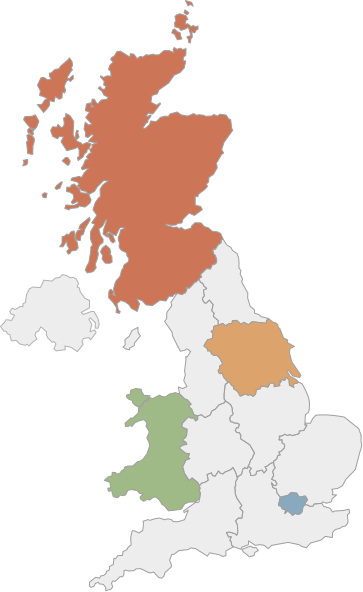
The immediate market impact was severe. According to data from Talysis and CD:UK, convenience stores lost over £5 million in vape sales in the first week following the ban, with weekly revenue falling from approximately £23 million to £17.8 million. Scotland experienced the sharpest decline at 36%, while Wales and Yorkshire saw drops of around 20%.
Consumer behaviour shifted rapidly in anticipation. Disposable vape usage fell from 44% in January 2024 to 24% by mid-2025. Among 18-24 year olds—the demographic most associated with disposables—usage dropped from 52% to 40%. The market is transitioning toward reusable pod systems, which saw an 11% sales increase in the weeks following the ban, and refillable devices that now form the backbone of compliant retail offerings.
Yet compliance remains uneven. Over £1 million worth of banned disposable vapes were sold in UK convenience stores during the first full week of the ban alone. In Yorkshire, disposables still accounted for 18% of vape revenue, raising questions about enforcement capacity. Trading Standards teams have begun seizures—Luton alone confiscated 926 illegal single-use vapes from five premises in the first month—but the illegal market continues to operate.
Disposable vape usage declined from 44% to 24%
A drop of 20 percentage points from Jan 2024 to Jun 2025. Pods/refillables gained 11 points (31%→42%) and other formats gained 9 points (25%→34%).
The regulatory cascade: confirmed measures
The disposable ban is merely the first of several regulatory waves that will reshape market economics:
Vaping Products Duty (1 October 2026): A flat £2.20 per 10ml excise duty applies to all e-liquids regardless of nicotine content. A standard 10ml bottle faces a 267% price increase from 99p to approximately £3.83 including VAT. The 100ml shortfill format—popular with experienced vapers—will carry £22 in duty alone. HMRC projects £530 million in annual revenue by 2029-30.
Vaping Duty Stamps Scheme (October 2026): All vapes must carry digital duty stamps with QR codes enabling instant verification of legitimacy. Businesses can register from April 2026, with mandatory implementation by autumn 2026 and a six-month grace period for selling unstamped stock. This creates both compliance burden and opportunity—legitimate operators gain a visible signal distinguishing them from illicit traders.
Tobacco and Vapes Bill age restrictions (1 January 2027): The generational smoking ban takes effect, making it illegal to sell tobacco products to anyone born on or after 1 January 2009.
Retail licensing scheme (date TBC—expected 2027): Both personal licences and premises licences will be required to sell tobacco, vapes, and nicotine products. The scheme covers both in-person and online retailers. Operating without a licence will constitute a criminal offence carrying unlimited fines on conviction, with £2,500 fixed penalty notices available for on-the-spot enforcement.
Single-use disposable vapes banned nationwide
Flat £2.20 per 10ml excise duty on all e-liquids
Digital QR codes required on all vape products for verification
Illegal to sell tobacco to anyone born on/after 1 Jan 2009
Personal and premises licences required to sell tobacco/vapes/nicotine
EU Tobacco Products Directive revision applies to Northern Ireland
The regulatory pipeline: pending measures under consultation
The Tobacco and Vapes Bill, currently in House of Lords committee stage, grants ministers sweeping powers to introduce further restrictions through secondary legislation. Several measures remain under active consultation or have been tabled as amendments:
Flavour restrictions (consultation ongoing): The October 2025 call for evidence seeks input on substances and ingredients used to create flavours. While nothing is confirmed, the direction of travel suggests restrictions on flavours deemed to appeal to children—potentially limiting options to tobacco, menthol, mint, and simple fruits. Implementation timing remains undefined pending consultation outcomes.
Packaging and display restrictions (powers granted, details TBC): Ministers will have authority to regulate packaging designs, point-of-sale displays, and product presentation to reduce youth appeal. Exact requirements await secondary legislation following consultation.
Minimum pricing amendment (proposed): An amendment tabled during Commons committee stage proposed a £30 minimum price for vape products, including individual coils and pods. This would nearly double average vape kit costs and triple pod/coil prices. The amendment's fate in the Lords remains uncertain.
Prefilled pod prohibition (proposed): Another amendment would ban the manufacture, supply, and sale of prefilled single-use vaping pods—sealed cartridges not intended for refill. This would eliminate the "next step up" from disposables, pushing consumers toward fully refillable systems.
Vape-free places (consultation pending): Powers exist to extend smoke-free restrictions to include vaping in certain settings. The government's preferred starting position includes areas where children are present—schools, playgrounds, hospitals—though outdoor hospitality settings are explicitly excluded. Full consultation required before implementation.
Nicotine limits and product standards (evidence gathering): The call for evidence seeks information on appropriate nicotine levels for products like nicotine pouches, and whether current TRPR limits (20mg/ml) should be amended.
"Polluter pays" levy (proposed): MPs in the All-Party Parliamentary Group on Smoking and Health have proposed requiring tobacco and vape producers to fund stop-smoking services—potentially raising up to £700 million annually. This remains a proposal rather than confirmed policy.
The critical takeaway: the regulatory environment will remain unstable for 18-24 months as secondary legislation develops. Businesses must build operational flexibility to adapt to restrictions that remain undefined.
Vaping Products Duty Impact Calculator
Estimate pricing impact after the October 2026 Vaping Products Duty comes into force
Duty impact
Estimate pricing after the October 2026 Vaping Products Duty.
Example: a 10ml bottle at £0.99 today reaches ~£3.83 after duty and VAT.
2.Regulatory Differences: Wholesalers, Distributors, Retailers, and E-Commerce
Distinct compliance obligations by business type
The UK regulatory framework creates different obligations depending on where a business sits in the supply chain. Understanding these distinctions matters for both compliance planning and payment processor due diligence.
Producers (manufacturers and importers)
Under TRPR, "producers" bear the heaviest regulatory burden. This includes anyone who manufactures, imports, or re-brands vaping products as their own. Producers must submit product notifications to MHRA six months before placing products on market (£150 per product plus £80 annual fee), provide detailed information on ingredients, emissions, nicotine delivery, and toxicological data, complete annual sales reporting to MHRA, register with EU-CEG separately for Northern Ireland market access, and maintain compliance with product safety standards (tank limits, nicotine concentrations, labelling).
Distributors and wholesalers
Distributors occupy a middle position—their activities don't affect product safety, but they carry specific obligations. Under the proposed licensing scheme, distributors face fines up to £100,000 for operating without a licence or breaching licence conditions (versus £10,000 for retailers). They must ensure they only stock and sell compliant goods, are required to train staff in correct handling and storage of vaping products, cannot stock products deemed "overtly youth appealing", must meet marketing, environmental (WEEE), and business obligations, are subject to regular inspections for compliance verification, and under the proposed four-strike penalty system, face maximum penalties ten times higher than retailers.
The higher penalty threshold reflects distributors' role in supply chain integrity—a single non-compliant distributor can supply dozens of retail outlets with illicit products.
Retailers (in-person)
Brick-and-mortar retailers face the most direct enforcement interface. Under proposed licensing, they require both personal licence and premises licence, face maximum fine of £10,000 for operating without licence or breaching conditions, receive £200 fixed penalty notices for age-of-sale and proxy purchasing offences, must operate age verification (Challenge 25) procedures, cannot display products in ways that appeal to children (specifics pending consultation), must offer WEEE take-back service for used vapes if selling electrical vape products, and are subject to Trading Standards inspections and test purchases.
E-commerce and online retailers
Online vape sales carry additional complexity: same licensing requirements as in-person retail under proposed scheme, must implement robust online age verification systems, prohibited by major processors (Stripe, PayPal) regardless of compliance status, Square explicitly prohibits online/telephone/mail order vape transactions while permitting in-store, higher chargeback risk due to delivery disputes and age verification failures, cross-border sales to Northern Ireland require separate OHID registration, and distance selling to EU prohibited or heavily restricted post-Brexit.
Payment processing implications by business type
The business model significantly affects payment processor risk assessment:
Wholesale/B2B operations often rely more heavily on invoicing, bank transfers, and trade credit rather than card processing—reducing but not eliminating payment infrastructure needs. However, B2B merchants processing card payments face the same high-risk classification, with processors requiring documentation of supplier agreements and compliance certifications, TRPR notification records for products distributed, WEEE producer registration, and VAT registration and trading history.
Retail operations with primarily in-store, card-present transactions present lower risk profiles due to reduced fraud and chargeback exposure. Some processors (including Square) specifically permit in-store vape transactions while prohibiting e-commerce—creating viable processing pathways for pure-play brick-and-mortar operations.
E-commerce operations face the most restrictive payment landscape. The combination of high-risk product classification, elevated chargeback rates (delivery disputes, age verification refusals), and card-not-present fraud exposure creates the harshest processor terms—or outright prohibition from mainstream providers.
Multi-channel operations must often maintain separate merchant accounts for different sales channels, with distinct rate structures, reserve requirements, and compliance documentation for each.
3.The Binary Payment Landscape
Where major processors stand
The payment processing landscape for UK vaping businesses divides into those with access to institutional providers and those forced into high-risk aggregators. Understanding this divide is essential for strategic planning.
Stripe and PayPal maintain explicit prohibitions on vaping merchants. Stripe's Acceptable Use Policy categorically bans tobacco and e-cigarettes with no exceptions. PayPal theoretically offers "pre-approval" but systematically denies it, citing "complex legal and payment industry requirements."
The November-December 2020 PayPal enforcement action remains a defining industry moment. More than 50 UK vape businesses had accounts terminated simultaneously, with funds frozen for up to 180 days. Businesses found themselves unable to purchase stock, pay shipping costs, or process customer refunds. The Independent British Vape Trade Association (IBVTA) issued emergency guidance and established partnerships with alternative providers in direct response to the crisis.
Square permits in-store vape sales but prohibits online, telephone, and mail order transactions—a partial solution for brick-and-mortar retailers that leaves e-commerce operations exposed. Adyen classifies vaping as "Restricted" requiring enhanced documentation and onboarding, but explicitly prohibits platforms and marketplaces from facilitating online vape sales.
Prohibited
Explicit ban on tobacco/vaping in AUP
Pre-approval offered but rarely granted
Restricted / Partial Support
In-store allowed; online/phone orders blocked
Enhanced onboarding; marketplaces blocked
Supported
Institutional backing for compliance-ready businesses
Best for: Long-term stability & rate negotiation
Fast setup for POS and e-commerce
Simplified pricing; e-com ready
The institutional pathway
The IBVTA has established formal partnerships with payment providers specifically to address these challenges. Worldpay—a global acquiring leader—offers IBVTA members access to secure payment gateway services, tokenisation, PCI DSS-compliant processing, recurring payments, and virtual terminal capabilities. WorldNet Payments provides competitive rates with fast setup for both point-of-sale and e-commerce. Trust Payments offers simplified pricing with integration into popular e-commerce platforms.
These partnerships exist because individual vape businesses struggle to establish institutional relationships independently. Trade association membership creates a vetting layer that reduces processor risk assessment burden—the association's compliance standards serve as a proxy signal for individual merchant legitimacy.
The distinction matters. Businesses accessing institutional providers through established channels operate with fundamentally different economics than those relying on high-risk aggregators discovered through internet searches. Settlement times, reserve requirements, fee structures, and account stability all differ substantially.
Card network registration requirements
Regardless of processor choice, vaping merchants face card network fees that reflect the industry's "high-risk" classification. Mastercard charges a $950 annual high-risk registration fee (increased from $500 in April 2024), while Visa charges $500 annual registration for online tobacco/vape merchants exceeding keying thresholds.
These fees become negligible for businesses processing sufficient volume but represent meaningful overhead for smaller operators—another factor favouring scale and institutional relationships.
4.Quantifying the Total Cost of Payment Instability
Beyond headline processing rates
The true cost of operating without stable, institutional payment infrastructure extends far beyond the quoted transaction percentage. A comprehensive accounting reveals cumulative margin erosion that makes sustained growth difficult.
For a business processing £100,000 monthly through high-risk aggregator accounts:
Direct transaction costs: High-risk processing rate of 3.49%–6.5% + 20-35p per transaction compared to standard retail benchmark of 1.5%–2.0% creates a monthly differential of £1,500–£4,500.
Rolling reserve capital cost: Typical reserve of 10% of transactions held for 180 days means £60,000 capital locked at any time. At 8% annual return, the opportunity cost is £400/month—monthly impact: £400.
Additional fees and charges: Chargeback fees of £15-25 per incident (vs. £10-15 standard), monthly account fees of £30-50, PCI compliance fees of £79-120 annually, and high-risk registration fees of £500-950 annually combine for a monthly impact of £100-150.
Hidden operational costs: Extended settlement (72+ hours vs. next-day) creates cash flow friction, documentation requirements consume management time, and compliance monitoring adds staff overhead—estimated monthly impact: £200-500.
Total monthly cost of payment instability: £2,200–£5,550
Annual impact: £26,400–£66,600
For a business operating on 30% gross margins, this represents 8-22% of gross profit consumed by payment friction—capital that cannot fund inventory, marketing, staff, or expansion.
Calculate Your Monthly Survival Tax
Compare high-risk aggregator pricing with institutional rates using your numbers
Monthly survival tax
Compare high-risk aggregator pricing with institutional rates using your numbers.
Total aggregator burden (fees + reserve cost): £5595
The termination catastrophe
The calculations above assume stable processing. Account termination introduces catastrophic costs that dwarf ongoing fees:
Immediate revenue loss: During the 2020 PayPal enforcement wave, businesses reported complete inability to process online orders for 2-4 weeks during emergency processor transitions. For a business averaging £25,000 weekly in e-commerce revenue, this represents £50,000-£100,000 in lost sales.
Fund freeze: Terminated accounts face 180-day fund holds. A business with £30,000 in processor float loses access to working capital for six months—potentially forcing emergency borrowing or supplier payment defaults.
MATCH listing risk: Termination for certain violations places merchants on the Member Alert to Control High-Risk (MATCH) list, affecting ability to secure processing from any Mastercard-connected acquirer for five years.
Transition costs: Emergency processor migration requires duplicated setup fees, rushed compliance documentation, potential website downtime, and customer communication explaining payment changes.
Supplier relationship damage: Businesses unable to reliably pay suppliers lose access to favourable payment terms, further compressing working capital.
The strategic implication: even if high-risk processing "works" today, the embedded termination risk represents a contingent liability that affects business planning, investment decisions, and—critically—enterprise value.
5.The Public Health Paradox
Government endorsement versus financial classification
The UK maintains the most pro-vaping public health stance globally, yet this endorsement translates poorly into financial sector treatment. Understanding this disconnect illuminates both its persistence and potential resolution pathways.
Public Health England's 2015 landmark review established that vaping is approximately 95% less harmful than smoking—a finding that continues shaping UK policy. The Office for Health Improvement and Disparities maintains that vaping "poses a small fraction of the risks of smoking." The NHS actively promotes vaping as a cessation tool, stating users are "roughly twice as likely to quit smoking" compared to other nicotine replacement products.
The Swap to Stop scheme—launched April 2023 with £45 million funding—represents a world-first: government distribution of one million free vape starter kits through NHS stop smoking services. Local NHS programmes from Kent to Bristol offer free vapes alongside behavioural support. Professor Ann McNeill of King's College London has described e-cigarettes as a "game changer in public health."
Yet payment processors evaluate different variables. Card networks and acquiring banks assess regulatory uncertainty (vaping laws change frequently across jurisdictions), chargeback rates (elevated due to product disputes and age-related delivery refusals), reputational risk (association with tobacco, addiction, and youth access concerns), and age verification complexity (creating fraud exposure and compliance burden).
Public health endorsement addresses none of these processor concerns directly. The NHS recommendation that vaping helps smokers quit is irrelevant to a risk model focused on chargeback ratios and regulatory stability.
Public health lens
Financial/processor lens
NHS promotes vaping as cessation tool
Processors evaluate chargebacks and underwriting risk
Public Health England: 95% less harmful
Card schemes treat vaping alongside gambling/adult
Government funds Swap to Stop kits
Aggregator accounts apply reserves and delays
Goal: reduce smoking prevalence
Goal: minimise fraud, regulatory exposure, reputational risk
The path to financial normalisation
Comparison to other regulated sectors suggests gradual normalisation is possible but requires regulatory stability:
Gambling: Achieved payment normalisation through clear UK Gambling Commission licensing. Licensed operators access standard payment rails; unlicensed offshore operators remain excluded. Regulatory clarity—not moral rehabilitation—enabled financial normalisation.
Alcohol: Merchants pay 3-5% processing fees initially but can graduate to lower rates with established history and proper licensing. The licensing framework creates processor confidence.
CBD: Seeing gradual improvement as clearer THC limits emerged and mainstream retailers (Boots, Holland & Barrett) began stocking products. Regulatory clarity enables financial normalisation.
The retail licensing scheme under the Tobacco and Vapes Bill could eventually provide similar architecture for vaping—clear licensing status that processors can verify, distinguishing compliant operators from the illicit market. But this requires years of stable implementation, not merely passage.
6.Market Consolidation and the Two-Tier Divide
Tobacco moves into vaping
Japan Tobacco International's May 2025 acquisition of a controlling stake in Flavour Warehouse—owner of Vampire Vape and operator of one of Europe's largest e-liquid manufacturing facilities—signals accelerating consolidation. JTI gained access to the UK's largest independent vape company, 80+ country distribution network, and 115,000 square foot manufacturing capability.
Supreme PLC (AIM: SUP) represents the publicly-traded benchmark. The company secured master distribution for Elf Bar and Lost Mary in June 2023, generating £63.5 million in first-year revenue from the arrangement. FY2024 results showed £221.2 million revenue (up 42% year-over-year) and £30.1 million pre-tax profit. Trading at approximately 8-9x EV/EBITDA, Supreme demonstrates the valuations achievable for scaled, compliant operators with institutional infrastructure.
UK Vapour Brands/Totally Wicked reached £119 million revenue in FY2024 (doubled from £54.4 million in 2022) with 150+ retail stores and supply relationships covering 60%+ of UK independent vape shops. Vertical integration—manufacturing, wholesale, retail—creates operational resilience that smaller competitors cannot replicate.
The infrastructure divide
Consolidation creates divergent operational realities:
Tier 1 operators (tobacco-backed, PE-funded, or publicly traded) benefit from existing banking relationships spanning decades, balance sheet strength eliminating rolling reserve requirements, established compliance infrastructure, volume leverage enabling rate negotiation, and dedicated merchant banking facilities.
Tier 2 operators (independents relying on aggregator accounts) face elevated processing rates (3.5%-6.5% vs. sub-2%), 10-15% rolling reserves locked for 180 days, 3-5 day settlement delays vs. next-day, account termination risk at processor discretion, and limited negotiating leverage.
The differential compounds over time. Tier 1 operators reinvest margin advantages into inventory, marketing, and expansion. Tier 2 operators consume margin on payment friction, limiting growth capacity. The gap widens with each operating cycle.
What signals legitimacy
Payment processors and institutional partners assess legitimacy through observable indicators: trade association membership (IBVTA, UKVIA), TRPR notification compliance documentation, age verification technology implementation, WEEE producer registration, multi-year processing history with documented chargeback ratios, audited financial statements, diversified product portfolios and distribution channels, and supplier agreements with recognised wholesalers.
Businesses seeking to transition from Tier 2 to Tier 1 access must systematically build these credentials. Each element serves dual purposes: satisfying regulatory requirements while signalling lower risk to financial partners.
7.The Northern Ireland Complexity
Dual compliance burdens
The Windsor Framework maintains Northern Ireland's alignment with EU regulations while keeping it within the UK customs territory, creating unique challenges for businesses serving the entire UK market.
Products sold in Northern Ireland must comply with EU TPD (Tobacco Products Directive) and use the EU Common Entry Gate (EU-CEG) notification system. Great Britain products follow UK TRPR with MHRA notification. Though current product standards are functionally identical—2ml tank limits, 10ml e-liquid bottles, 20mg/ml nicotine caps—the systems require separate regulatory registrations (EU-CEG and MHRA), separate compliance documentation, attention to divergent labelling requirements (EU vs. UK health warning images), and different notification timelines and procedures.
The pending TPD3 revision—expected in late 2025 with 2027-2028 implementation—introduces substantial uncertainty. Potential EU changes including flavour restrictions, nicotine pouch regulations, and stricter packaging requirements would apply in Northern Ireland but potentially not Great Britain.
The UK Vaping Industry Association has warned that if "Northern Ireland were to be locked-in to these regulations it could be hugely detrimental to vapers and smokers looking to quit." Businesses must monitor EU regulatory developments that may apply only to their NI operations.
Great Britain
- TRPR with MHRA notification
- UK labelling and warnings
- Same standards as EU today (2ml/10ml/20mg)
Northern Ireland
- EU TPD with EU-CEG submissions
- EU labelling requirements
- Subject to TPD3 changes first
Cross-border considerations
GB retailers selling to NI customers must complete OHID registration describing age verification systems used. This administrative layer increases compliance surface area that payment processors evaluate when assessing merchant risk.
The strategic implication: businesses operating across GB and NI must maintain dual compliance capabilities, separate labelling, and awareness of diverging regulatory trajectories. This operational sophistication favours larger, institutionally-backed players over independents managing compliance manually.
8.The Illicit Market and Compliance Premium
Enforcement reality
The scale of illicit vaping in the UK creates both competitive pressure and strategic opportunity for compliant operators.
Over five years, Trading Standards seized nearly 3 million illegal vapes worth approximately £21 million. In 2024 alone, 1.19 million illegal vapes were seized (59% increase year-over-year), 1,435 cases of businesses stocking or selling illegal products were identified, only 10% of identified cases resulted in fines or penalties, 108 retailers received premises closure orders (double the 2023 figure), and total fines issued came to just £48,062.
London accounted for 47% of all English seizures, with Hillingdon (home to Heathrow) representing the UK's primary entry point for illegal products. The proximity of major transport hubs to illegal vape importation is not coincidental—criminal networks exploit customs capacity constraints.
The £30 million annual enforcement funding announced in the 2025 Budget, combined with new powers for HMRC and Border Force to seize illicit products on sight, signals increased regulatory pressure. Yet enforcement capacity remains overwhelmed by illegal market scale—an estimated two-thirds of total vape volume may be illicit.
Compliance as competitive advantage
For legitimate operators, the enforcement environment creates strategic opportunity. The duty stamp requirements from October 2026—digital QR codes verifying product legitimacy—will enable instant differentiation between legal and illegal products.
Businesses with documented compliance infrastructure benefit from processor confidence (demonstrated regulatory adherence reduces perceived risk), retail partnerships (major chains require verified supply chains), enforcement protection (clear documentation prevents mistaken seizures), and consumer trust (verifiable legitimacy becomes a marketing advantage).
The retail licensing scheme creates additional separation. Licensed operators can operate openly; unlicensed competitors face fines and closure orders. The compliance burden that seems onerous today becomes a barrier protecting licensed operators from illicit competition tomorrow.
Compliance readiness checklist
Check off each item as you put it in place. Your backup kit should be complete and tested before you need it.
Your compliance readiness:
0 / 6 complete
9.Strategic Pathways to Operational Resilience
Building enterprise value through financial infrastructure
Payment infrastructure is not merely operational plumbing—it is strategic infrastructure that determines operational capability, margin structure, and enterprise value. Businesses that treat it accordingly position themselves for resilience regardless of whether their ultimate goal is growth, profitability, generational transfer, or eventual exit.
Trade association partnership provides immediate pathway to institutional access. The IBVTA's relationships with Worldpay, WorldNet, and Trust Payments exist precisely because individual vape businesses struggle to establish these connections independently. Membership creates a vetting layer that reduces processor risk assessment burden while providing access to enterprise-grade capabilities: tokenisation, PCI DSS compliance, recurring payments, virtual terminal, and stable settlement.
Compliance documentation excellence serves multiple purposes simultaneously. TRPR notifications (£150 per product plus £80 annual fee), age verification system implementation, WEEE producer registration, and retail licensing preparation all create paper trails that demonstrate legitimate operation. This documentation becomes processor-ready evidence of operational sophistication.
Processing history cultivation matters enormously. Businesses should target 6+ months of clean processing history, sub-1% chargeback ratios (industry benchmark: 0.5-0.8%), documented fraud prevention measures, and clear refund policies reducing dispute rates.
This track record enables rate renegotiation, reserve reduction, and potential graduation to preferred merchant status. Multiple processor relationships provide redundancy against termination risk while demonstrating sophisticated financial management.
Product portfolio diversification reduces concentration risk. The disposable ban demonstrated category-specific vulnerability—businesses solely dependent on banned products faced existential pressure. Those with refillable pod systems, e-liquids, hardware, and accessories across multiple channels demonstrate adaptability that both processors and partners value.
Infrastructure documentation checklist
Essential documentation for institutional processor onboarding. Check off items as you complete them.
Processors require documented proof of age-verification systems. Keep vendor contracts and process documentation ready for due diligence.
Maintain a folder of all product notification confirmations from MHRA and EU-CEG. Processors verify compliance during onboarding.
Track monthly chargeback volumes and ratios. Low rates (<1%) are critical for securing institutional processing terms.
Gather evidence of compliance preparation for the 2027 retail licensing scheme. Early preparation signals reliability to processors.
Document distinct labelling protocols for Great Britain (TRPR) and Northern Ireland (EU TPD) to demonstrate regulatory awareness.
Keep WEEE registration certificates accessible. Environmental compliance is verified during processor onboarding for electrical products.
The compound effect
Each element of institutional infrastructure reinforces others: trade association membership leads to processor access, which enables better rates and improved margins; compliance documentation reduces perceived risk, leading to reduced reserves and better cash flow; processing history creates negotiating leverage, enabling rate improvements and reinvestment capacity; and diversified portfolio generates revenue stability, building processor confidence and account security.
Businesses trapped in high-risk aggregator accounts cannot access this virtuous cycle. They absorb the "survival tax" year after year, consuming capital that could fund the very infrastructure investments that would reduce their costs.
The strategic choice is clear: invest in institutional infrastructure now, accepting short-term costs and complexity, to access the compound benefits that enable long-term competitive advantage. Or remain in the high-risk tier, absorbing margin penalties that make genuine growth investment impossible.
10.Conclusion: Financial Infrastructure as Competitive Moat
The UK vaping industry's next 24 months will determine which businesses thrive and which exit the market. The disposable ban has already reshaped the landscape. The Vaping Products Duty (October 2026), duty stamp requirements (April 2027 registration, autumn 2027 mandatory), retail licensing, and potential further restrictions on flavours, packaging, and product types will create successive hurdles that favour scaled, institutionally-connected operators.
Payment processing capability sits at the centre of this transition. Businesses with stable, institutional payment relationships can weather regulatory changes without operational disruption, fund compliance investments from operating cash flow, negotiate supplier terms from positions of stability, and present clean financials supporting any strategic option—growth, distribution, or exit.
Those dependent on high-risk aggregators face a permanent margin penalty while operating with termination risk that can crystallise at precisely the moments when stability matters most.
The government's continued endorsement of vaping as a public health tool and the industry's consolidation toward institutional backing suggest eventual normalisation of payment treatment. But that normalisation will arrive first for businesses that invested early in legitimate, compliant infrastructure.
The "survival tax" is not inevitable. It is a strategic choice—or more precisely, a consequence of not making the strategic choice to build institutional-grade financial infrastructure. Businesses that act now position themselves for whatever outcome they choose: aggressive growth, sustainable profitability, generational succession, or premium valuation.
Those that wait will find the gap increasingly difficult to close.
Glossary
Key terms used throughout this guide. Click any term to expand its definition.